


I’ve often used a metaphor for spiritual maturity that has helped myself and (I believe) others to transform the way we approach the subject. So I thought, “Why not share it here?”
The metaphor is actually quite simple as it borrows from the traits of physical maturity. I won’t go into exacting detail here, but in the natural sense, humans pass through several stages of physical maturity. We’ll draw on a few for this metaphor: infancy, toddlerhood/childhood, and adulthood. Feel free to expand this list and metaphor if you like, but we’ll start with a quick look at these three stages and draw some simple observations.
First, when a child is born and growing through infancy, they are heavily reliant on other people. Someone else has to feed them, clean them, love them, protect them, everything. They are largely, if not completely, reliant on outside help for their nourishment and physical well-being.
As the child grows and becomes more self-sufficient, they gradually take on more and more responsibility for their own care and development. They can (over time) learn to feed themselves, clean themselves, clothe themselves, and maybe even protect themselves. They still rely on others for some things, but they grow to a point where they are capable of providing for most of their own needs.
Finally, the person reaches adulthood and something fascinating happens. No longer is the person simply capable of looking after their own well-being, and providing for their own needs, but they learn to also look after and provide for others. The adult can prepare a meal for others, can help clean them, love them, and protect them. They recognize the value of community and learn to let go of the silly notion that they “have to do everything themselves.”
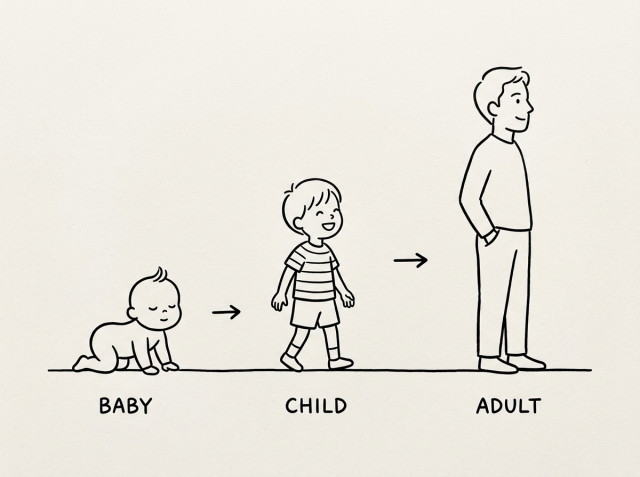
You probably already see where this is going. The same process of physical maturity applies to our process of spiritual maturity.
When we are “born again” as new/young Christians, we need someone else to provide us with spiritual nourishment. “I’m just not getting fed at my church,” is a perfect example of a statement I’d expect to hear from a spiritual infant. Baby Christians are relying on others who are more spiritually mature to help them learn the basics and grow in the infancy stages of their faith. People in this stage might seldom, if ever, read the Bible for themselves because they don’t know where to start or how to get anything meaningful out of the text…yet.
But just like physical infancy, this stage shouldn’t last very long. Spiritual infants should mature into spiritual children in just a few years, at the most.
In spiritual childhood, then, the Christian is comfortable and capable of reading and studying the Bible for themselves. They might take up an interest in reading C.S. Lewis, Martin Luther, or other thinkers and leaders in the Church. These are capable of finding and providing for their own spiritual food. No devotional program? No problem. Just give them the Bible, maybe a journal and a pen, and they’re good to go.
This is a good milestone to reach, but it’s still a relatively small percentage of our lives – maybe ten years or so.
Then we reach spiritual adulthood. This is when we have grown beyond a simple “need” to look after our own well-being and growth, and now begin to look after the spiritual well-being of others. The “spiritual adult” Christian not only reads and studies the Bible on a regular basis (without needing to be asked or encouraged), but they frequently prepare “meals” for others – spiritual lessons, studies, and takeaways. The spiritual adult has long since learned their spiritual giftings, and they lean into these gifts while ministering to others. Prophets, teachers, pastors, leaders, givers, servers, encouragers, discerners, apostles, and all the rest. The spiritual adult recognizes that the process of preparing spiritual nourishment for others doesn’t always look the same, even as we eat many types of physical foods and meals.
We become more outward focused in our priorities rather than inward focused. This continues to grow and develop for the rest of our lives.
A couple of notes worth mentioning include:
- Each step is natural and healthy. We can’t become spiritual adults by skipping the infancy and childhood stages.
- Each step has a natural and healthy duration (excepting for adulthood, which I suppose you could say continues on until we die). Nobody should remain an infant or child for their entire life.
- We are better/stronger together. It is the responsibility of spiritual adults do everything in our power to help cultivate and develop those in our spheres of influence who are younger in their faith journeys, and to do so with grace and patience.
And there we have it. Like any other metaphor, we can poke a thousand holes in it. If you find this metaphor to be helpful, feel free to use it. If not, don’t.


Make a one-time donation
Make a monthly donation
Make a yearly donation
Choose an amount
Or enter a custom amount
Your contribution is appreciated.
Your contribution is appreciated.
Your contribution is appreciated.


Excellent blog, Joel – thanks!
LikeLiked by 1 person