Welcome to part 7 of our exploration into the polytheism context clue. Part 6 was a little scholarly and dense, so let’s take a brief step back as we complete our precursory examination of the first form of Biblical polytheism. We will then move on to the second form in next week’s post.
As a reminder/refresher from part 2 of this series, there are at least two forms of Biblical polytheism. The first is the polytheism that kept getting the Israelites into trouble – worshipping other gods, serving idols, forgetting the God of Abraham, Isaac and Jacob. I call this “Biblical polytheism” simply because it appears in the Bible.
The second form of Biblical polytheism evaluates and informs our understanding of the unseen realms, and specifically the role of angels, demons, powers, principalities, rulers of darkness, spiritual forces of wickedness in the heavenly places (Eph. 6:12), and so on. But again, we’ll address this second form next week.
So today, let’s conclude our assessment of the first form by illustrating John Walton’s observation once more. After that, we’ll conclude with a small list of some of the pagan gods the Israelites worshipped as idols (as recorded in the Bible).
John Walton observed that “Like everyone else in the ancient world, the Israelites believed that everything that happened and everything that existed found its ultimate cause in deity.”
Because of this, religion was a central component of every major empire, kingdom, nation and tribe. One of the ways we see this reinforced in scripture is in the naming conventions employed by each people group. Very often, and especially when influential kings and leaders were involved, people were named with a particular designation to honor their god (or one of their gods). For example, consider the Babylonian kings Nabopolassar and Nebuchadnezzar whose names both start with “Nebo,” as in the god of writing, literacy, and wisdom. There’s also Belshazzar (in Daniel 5) whose name begins with “Bel,” the head of the Babylonian pantheon.
Consider Ashurbanipal, the last “great” king of the Assyrians. What does his name start with? “Ashur,” the supreme god of the Assyrians. Or look at Sennacherib, whose name starts with “Sin,” the Assyrian moon god.
Thutmose, the Egyptian Pharaoh was named for Thoth, the Egyptian god of wisdom and literature, and Amenhotep was named for Amun (sorry, I didn’t include this one in our lists).

Now if you’ve been around the church for a while, or if you’ve ever read the OT, you’re probably not surprised that the Israelites did the very same thing. Their names almost always held significant meaning, and many times they were directly related to God. Take my namesake, for example: Joel (Jo-el). “Jo” is the English equivalent of “Yo” in Hebrew, and is a shortened version of “Yehovah,” most commonly referred to as “the Lord” in the scriptures. The Israelites wouldn’t use God’s proper name (usually) out of reverence (“Yohd-vev-ha-vev” – or “Yahweh”) so they would either use “Yehovah” to refer to the Lord, or the more generic term “Elohim” to refer to “God” (or a godlike entity). The shortened form of “Elohim” is “El,” like the Canaanite god. So when we fuse these two things together, my name means “The Lord is God.”
Here’s a fun exercise to further illustrate this point. In the book of Daniel, we see four young Israelites taken into captivity, who were then brought to Babylon and instructed/indoctrinated in the ways, language and cultural customs of the Babylonians. During this process, the commander of the officials assigned new names to each of them.
Daniel, whose name means “Judge of God,” was given the Babylonian name Belteshazzar, which means “Bel’s prince.” Hananiah (“God is gracious”) received the name Shadrach (“Under the command of Aku” – another Babylonian god). Mishael (“Who is like God?”) received Meshach (“Who is like Aku?”). And Azariah (“God is my helper”) received Abednego (“Servant of Nebo”).
Hopefully these few examples help us to better appreciate the centrality of deity and religion within these ancient cultures. Coincidentally, we do the same thing today, although we give our gods different names, and are less obvious about including them in our naming conventions. But I digress.
Let’s finish our exploration of the first form of Biblical polytheism with a few scriptural references you can look up (if you’re so inclined). I’ll only include a short list of the pagan gods worshipped by Israel in 2 Kings (for simplicity’s sake). You can find many more references throughout the OT:
- Baal-zebub (2 Kings 1:2)
- Baal (2 Kings 3:2)
- Rimmon (2 Kings 5:18)
- Asherah (2 Kings 13:6)
- Ashima (2 Kings 17:30)
- Nergal (2 Kings 17:30)
- Succoth-Benoth (2 Kings 17:30)
- Adrammelech (2 Kings 17:31)
- Anammelech (2 Kings 17:31)
- Nibhaz (2 Kings 17:31)
- Tartak (2 Kings 17:31)
- Nisroch (2 Kings 19:37)
- Molech (2 Kings 23:10)
- Ashtoreth (2 Kings 23:13)
- Chemosh (2 Kings 23:13)
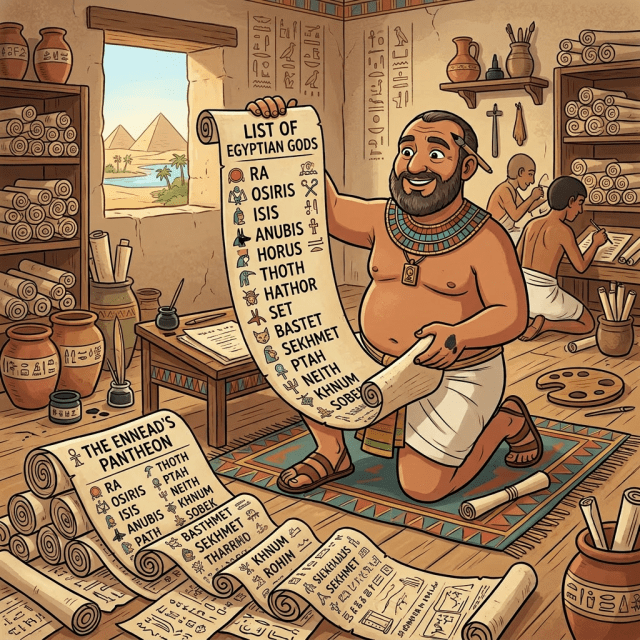
Phew. Lot’s of lists, and lots of gods!
I know it can be a dizzying and daunting task to consider all of these factors, but I’m convinced it’s worth the effort. When we take the time to consider and appreciate the “commonplace” world of the ancient Israelites, we can begin to make more sense of the “troublesome” passages we find in the OT. For example, did God ever really command the Israelites to murder and genocide the Canaanites? Probably not. The Israelites were simply following the forms and traditions of the cultures and pantheons surrounding them – attributing their violence as a command from God if they won, and attributing their losses to the anger and wrath, or punishment of God. Again, these are very common beliefs and assumptions within the polytheistic religions of the people historically surrounding Israel. When we add this to the myriad of OT passages explicitly forbidding violence and genocide (and hence, revealing the heart of God to be consistent with the heart of Jesus as seen in the NT), it seems obvious. I recognize this is an over-simplified response to the question, and some people might disagree.
That’s fine. It’s just an example and a practical way for us to apply some of the contextual insights we’ve been exploring around the subject of Biblical polytheism.
And with that, I think we can finally “close the page” on the first form of Biblical polytheism. Now, let’s take a look at the second form!
Make a one-time donation
Make a monthly donation
Make a yearly donation
Choose an amount
Or enter a custom amount
Your contribution is appreciated.
Your contribution is appreciated.
Your contribution is appreciated.

