Okay, so were the ancient Israelites polytheists or not?
What a wonderfully direct and pointed question. The answer, as you might have suspected, is much less direct and pointed: it depends. What do we mean when we use the word ‘polytheist?’
If you’ve been following along in the series, you’ll know that I’ve been focusing on two forms of Biblical polytheism, and if you haven’t been following the series, I’d suggest going back and reading the earlier parts – they really do build upon each other.
So why would I say that it depends what we mean by the word ‘polytheist?’ It’s a rather straightforward question, right? The answer should be a straightforward ‘yes’ or ‘no,’ so what’s the complication?
One of the complications is that there are multiple types of logic in the world, many of which are regularly employed by ourselves and others. Some have posited just two forms of logic, but there are more, and logic itself is one of the contributing factors to our world view lens (the way in which an individual views the world and everything in it).
I don’t want to go too deep on this tangent, but a brief illustration might be helpful to our present conversation, so I’ll emphasize two of the most well-known types of logic. In layman’s terms, the first view is the one we talk about the most in our modern Western culture, and that is the “either/or” school of logic. In more academic terms, this references the four fundamental laws of logic built on the foundational principle of non-contradiction. Either a statement is true, or it is false.
The second type of logic I want to mention is the “both/and” school of logic. In layman’s terms, this refers to the occasions when a statement is both true and false. This type of logic is sometimes assumed to be an Eastern concept, but that’s not accurate. Both forms of logic (the either/or and the both/and) are regularly employed across all people groups, times, and cultures. That’s as far as I’ll tread down this particular rabbit hole for now. If you’re interested in learning more about the different types of logic, look it up – do a research project. Nobody’s stopping you.

Okay, so back to our first question: were the ancient Israelites polytheists or not? I dare say the correct answer is both ‘yes’ and ‘no.’ (Do you like how I’ve employed the second form of logic here?) Our immediate follow up question, then, is: “what do you mean?”
Let’s start with the Shema in Deuteronomy 6:4,5.
Hear, O Israel! The Lord is our God, the Lord is one! You shall love the Lord your God with all your heart and with all your soul and with all your might.
When Israel was at their best, I believe they were mostly (or completely) worshipping the Lord alone, above all other gods. So in that sense, ‘no,’ the Israelites weren’t polytheists – they weren’t sharing their worship with other gods; they weren’t viewing other gods as equals to Yehovah. (And as we’ve mentioned before, there were quite a few times when they ran off after other gods, as well).
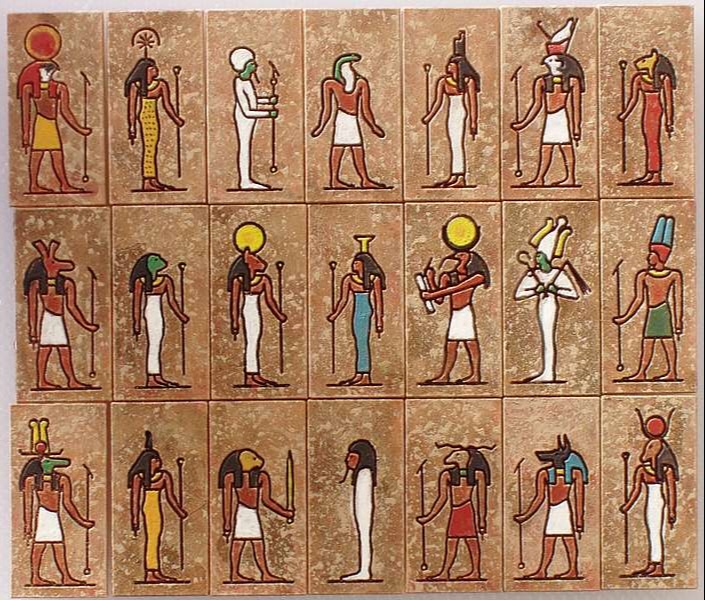
However, the way the ancient Israelites viewed things like gods, spirits, angels, demons, powers, principalities, and other spiritual forces was much more similar to the way everyone else in the ancient world thought about these things. Namely, the existence of numerous gods (spirits, powers, principalities, etc.) was never in question. Everyone believed in a rich and expansive spiritual realm – a place where the gods (etc.) lived and reigned in force. At certain times and occasions and places, one or more of the “gods” would act upon the physical world in a way that was (usually) consistent with their nature. And if you want a brief refresher on the “nature” of some of the gods in the pantheons surrounding ancient Israel, go back and look at parts 3 & 4 in this series.

To quote John Walton once more: “Like everyone else in the ancient world, the Israelites believed that everything that happened and everything that existed found its ultimate cause in deity.”
So in that sense, ‘yes,’ the Israelites were polytheists. And if I can be so bold as to offer a controversial statement, I think that we are all polytheists in the same way.
Before you start hurling stones at me, let’s swap out the word ‘god’ with something else. I know the word ‘god’ can be a bit of a trigger word for modern Christians. As you’ll remember from parts 8 & 9 in this series (go back and check them out if you like), the Hebrew words for ‘god’ and ‘spirit’ mean a whole lot of different things because their language had so many fewer words than modern English does, and they had to accomplish much more with each word.
For our sakes, let’s substitute the word ‘god’ with the words/concepts from Paul’s epistle to the churches in Ephesus. “For our struggle is not against flesh and blood, but against the rulers/principalities (ar-khay), against the powers (exsousia), against the rulers of the darkness in this world/age (kosmokrator ho skotos toutou aion/eon), and against the spiritual (pnuematikos) forces/wickedness (poneria) in the high/heavenly places (epouranios).”
Now of course Paul’s letter was written in Greek, so we have to do a bit of translating (see parts 8 & 9 again) in order to see the corollaries in Hebrew, but this gives us a strong vocabulary to work with in our conversation regarding Biblical polytheism.
For the sake of time, I’ll wrap up this week’s post here. Next week, we’ll take a look at a few practical examples of how this second form of Biblical polytheism functions in action. I hope to see you then!
Make a one-time donation
Make a monthly donation
Make a yearly donation
Choose an amount
Or enter a custom amount
Your contribution is appreciated.
Your contribution is appreciated.
Your contribution is appreciated.

