Just for a Closer Walk
“Constantly guide me into a closer walk with Thee.” -Haldor Lilenas
“Constantly guide me into a closer walk with Thee.” -Haldor Lilenas
Hey gang! I wanted to drop a quick update to let you know what I’ve been up to the past few weeks. I’m nearing the print release for my first fiction book, The Legends of Kezzog Book 1: Smiting the Orc King. It’s a humorous/comedy fantasy following a vainglorious dwarf warrior who helps his friend and a trio of kobolds track down the vile orc king, Blascouth.
It turns out there’s an awful lot of work that goes into producing a book, especially when I’m overseeing every detail of the process (hiring the cover designer, working with editors, getting the legal and business side of everything set up, and so on). I suspect the next month or so leading up to the release of the book will be exceptionally busy. I’ll do my best to post a new blog or two when I can, but it will probably be a bit light for a few more weeks.
Thanks for your understanding. I appreciate your readership and comments, and will do my best to continue posting helpful blogs.
-Joel
P.S. – if you happen to be a fan of humorous fantasy, or you would just like to support me, you can learn more at joeloslund.com There’s also a link on my website where you can sign up for my monthly newsletter, where I post regular writing updates and news, such as when and where you can find the print and audio versions of my book(s). Thanks again!


“…by the works of the Law no flesh is made righteous.” (Gal. 2:16c)
In Paul’s letter to the Galatians, he mentions a curious encounter he had with Peter (a.k.a. “Cephas”), which Peter had visited the church in Antioch, and all had been well…until… Other Jewish christians came up from Jerusalem, and suddenly Peter got nervous. He stopped dining with, and interacting with the Gentiles in the church, presumably on account of a cultural assumption that the Jewish Christians might frown upon him treating the Gentile christians as equals in the faith.
So Paul confronted him. Actually, the word in the NASB is, “Paul opposed him to his face.”
But that’s not what I want to talk about today. A lot of scholars and commentators have commented on Paul’s confrontation and the numerous factors playing into why this all happened in the first place. And plenty has been written and said about the theology of unity within the Church and the deleterious hazards of dissension or separation within the Church, so I’m not going to address that today.
I want to take a brief look at a phrase Paul used in verse 16. It’s actually inseparable from the surrounding verses (especially verses 14c-21), but this verse captures the essence of the whole passage, in my opinion.
“By the works of the Law no flesh will be justified.” (Gal. 2:16c NASB)
In verses 15 and 16, Paul reminds Peter (and probably the rest of the assembled Jews, given the fact that he was publicly opposing Peter to his face) that we are all made righteous by faith in Jesus Christ. None of us, therefore, have any advantage over one another (such as the Jews over the Gentiles in this passage). We all come to God on the same terms.
But Paul then takes it a step further here by referencing Psalm 143:2, “in Your sight, no living man is righteous (justified).” We see a delicate weaving together of the Ceremonial Law (the law of Moses, etc) with the much broader Moral Law. Paul addresses both laws at once.
“By the works of the Law no flesh will be justified.”
The Greek terms used here show us some of the layers and multiple meanings this phrase can have. First, the word “sarx” can mean flesh, meat, externality, the body, human nature, a human being, or even carnal activities and carnal thinking. “Dik-ah-yo-o” then means to render or show as just or innocent, free, justified, or to be righteous.
In one sense, the Ceremonial Law is addressed. By this, no person is justified. Simple and clean. But in another sense, the Moral Law is also addressed.
Morality is not a set of scales whereby we try to do equal measures of good and bad, perhaps a slight bit more good. By the works of the Moral Law, no carnal behavior is considered righteous, or balanced out to create a righteous person. (See how I re-interpreted the verse using the alternate meanings of the Greek words?)
In God’s sight, and in light of His perfect holiness, none of us are perfectly righteous. What this DOESN’T mean is that we live (or don’t live) “good lives,” or perform good actions and behaviors. What this means is that we don’t live perfectly RIGHT-ly according to our originally designed purpose. The point is about getting back to our primitive health and original design before the stains of the Fall, and this is only possible through a transformational faith in Jesus Christ.
It’s not about behavior modification. It’s about a radical transformation of our mind, body, and spirit through our faithful lockstep living with Jesus Christ, our Lord. In other words, “righteousness” in these verses (or “justification” depending on your translation) means “right-relatedness to God.”
Choose an amount
Or enter a custom amount
Your contribution is appreciated.
Your contribution is appreciated.
Your contribution is appreciated.


I’ve often used a metaphor for spiritual maturity that has helped myself and (I believe) others to transform the way we approach the subject. So I thought, “Why not share it here?”
The metaphor is actually quite simple as it borrows from the traits of physical maturity. I won’t go into exacting detail here, but in the natural sense, humans pass through several stages of physical maturity. We’ll draw on a few for this metaphor: infancy, toddlerhood/childhood, and adulthood. Feel free to expand this list and metaphor if you like, but we’ll start with a quick look at these three stages and draw some simple observations.
First, when a child is born and growing through infancy, they are heavily reliant on other people. Someone else has to feed them, clean them, love them, protect them, everything. They are largely, if not completely, reliant on outside help for their nourishment and physical well-being.
As the child grows and becomes more self-sufficient, they gradually take on more and more responsibility for their own care and development. They can (over time) learn to feed themselves, clean themselves, clothe themselves, and maybe even protect themselves. They still rely on others for some things, but they grow to a point where they are capable of providing for most of their own needs.
Finally, the person reaches adulthood and something fascinating happens. No longer is the person simply capable of looking after their own well-being, and providing for their own needs, but they learn to also look after and provide for others. The adult can prepare a meal for others, can help clean them, love them, and protect them. They recognize the value of community and learn to let go of the silly notion that they “have to do everything themselves.”
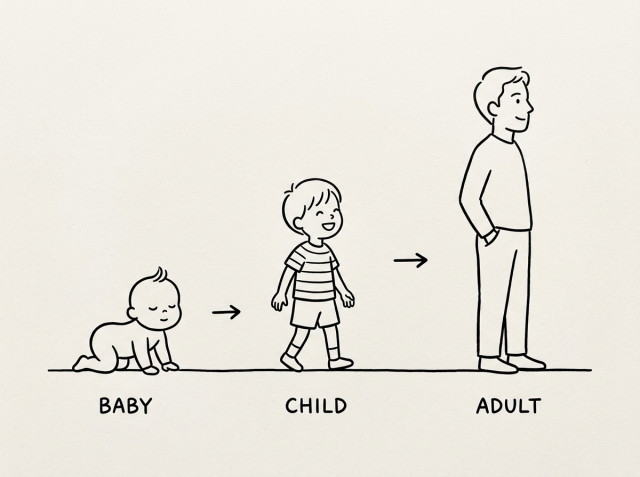
You probably already see where this is going. The same process of physical maturity applies to our process of spiritual maturity.
When we are “born again” as new/young Christians, we need someone else to provide us with spiritual nourishment. “I’m just not getting fed at my church,” is a perfect example of a statement I’d expect to hear from a spiritual infant. Baby Christians are relying on others who are more spiritually mature to help them learn the basics and grow in the infancy stages of their faith. People in this stage might seldom, if ever, read the Bible for themselves because they don’t know where to start or how to get anything meaningful out of the text…yet.
But just like physical infancy, this stage shouldn’t last very long. Spiritual infants should mature into spiritual children in just a few years, at the most.
In spiritual childhood, then, the Christian is comfortable and capable of reading and studying the Bible for themselves. They might take up an interest in reading C.S. Lewis, Martin Luther, or other thinkers and leaders in the Church. These are capable of finding and providing for their own spiritual food. No devotional program? No problem. Just give them the Bible, maybe a journal and a pen, and they’re good to go.
This is a good milestone to reach, but it’s still a relatively small percentage of our lives – maybe ten years or so.
Then we reach spiritual adulthood. This is when we have grown beyond a simple “need” to look after our own well-being and growth, and now begin to look after the spiritual well-being of others. The “spiritual adult” Christian not only reads and studies the Bible on a regular basis (without needing to be asked or encouraged), but they frequently prepare “meals” for others – spiritual lessons, studies, and takeaways. The spiritual adult has long since learned their spiritual giftings, and they lean into these gifts while ministering to others. Prophets, teachers, pastors, leaders, givers, servers, encouragers, discerners, apostles, and all the rest. The spiritual adult recognizes that the process of preparing spiritual nourishment for others doesn’t always look the same, even as we eat many types of physical foods and meals.
We become more outward focused in our priorities rather than inward focused. This continues to grow and develop for the rest of our lives.
A couple of notes worth mentioning include:
And there we have it. Like any other metaphor, we can poke a thousand holes in it. If you find this metaphor to be helpful, feel free to use it. If not, don’t.
Choose an amount
Or enter a custom amount
Your contribution is appreciated.
Your contribution is appreciated.
Your contribution is appreciated.


Did you know I’m an author?
Sure, I’m a writer – I’ve been maintaining this blog for several years, and all that. But I’m also a novelist – a storyteller.
(If you want to learn more about my writing career, my current projects and upcoming events, feel free to visit my website: www.joeloslund.com Also, if you’d like to read my stories, or listen while I narrate them with “top quality voice-acting,” I’d invite you join my Patreon community at: patreon.com/JoelOslund)
Today I want to briefly explore the power of stories.
Freelance journalist Katja Keuchnius outlined five of the great powers of stories. (Here’s a link to the original article: https://katjakeuchenius.nl/wetenschap/the-5-powers-of-story-telling/)
Here’s a brief summary of the five powers:
In addition to this list, I would add another power of stories: they feel safe to engage with. The characters in the stories aren’t us, so we can read or listen as the characters face terrible obstacles and dilemmas – obstacles and dilemmas which might be very similar to the ones we face in our own lives – but without us feeling threatened or defensive.

In the Bible, stories sometimes go by another name: parables!
Isn’t it curious how often Jesus taught through parables? Sure, he spoke in different ways to different people in different situations, and many of these were clear and literal. But most of his larger public addresses were riddle with parables. It’s almost as if he knew the power of stories.
Let’s consider a few examples:
The first parable, as short as it is, illustrates all of the powers listed above. There is action activation as the man finds a treasure, sells everything he has, and then buys the field. There is sensory engagement as we imagine what the field might look and smell like. There’s empathy and compassion as we see the man’s joy on display. The effects all produce a neural coupling effect, hinting at the deeper meaning or moral of the passage. And the parable serves as an innovation catalyst, suggesting a different way to think about the kingdom of heaven. Best of all, the parable is about some random “man,” not us. (Or is it?)
The second parable does the same thing, activating our motor cortex and sensory areas of the brain as we read about barns, crops, grains, and even the smell of fresh lumber that accompanies the building of a new barn. We empathize with the man’s thinking while sensing a deeper meaning, and learning, once more, to think differently than before. Seeing as how the parable has a “sad” ending for the man, we are twice as happy it’s a fictional character and not us.
The third parable, surprise surprise, illustrates all of the powers well. What sights and sounds and smells does this story evoke? What feelings? What empathy? One small thing to note in this parable is that the ten silver coins would have been the woman’s wedding dowry – similar to a modern day wedding ring. The coin itself held some monetary value, but the sentimental value was much higher.
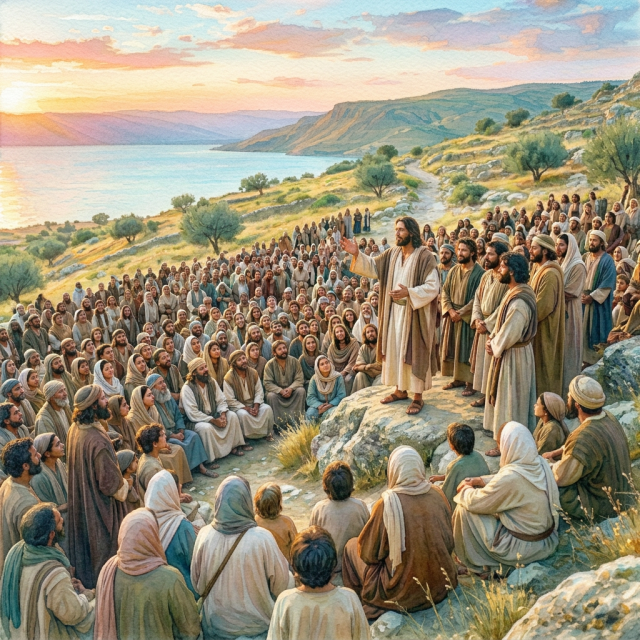
There are many more parables, of course, and many of them are much longer. Feel free to read them and see if you can identify the different “Story Powers” at work.
After that, you might take some time to consider how you mightemploy the power of stories moving forward so as to better communicate your most important messages.


Whatever you do, do it heartily, as unto the Lord (Col. 3:23)
Once upon a time there was a dreadful distinction between secular work and Christian work, secular products and Christian products. While I’m not opposed to the idea of claiming our work and products to be unique because of our Christian values, we mustn’t use this as an excuse for putting out low-quality or sub-par work.
For a long time, “Christian” music was considered “bad” music. “Christian” books and art were considered “second-rate” products. And “Christian” workers sometimes had questionable reputations around the workplace.
Fortunately, a lot of this has changed over the past twenty-five years or so. Actually, if you look back through the historical records, “Christian” music, books, art, and other forms of craftsmanship were classically synonymous with “excellence.” We just hit a weird little stride there for a while.
Now we have good music, powerful leaders, strong workers, and talented artists.
Good job, Church. Let’s keep it up.
In my humble opinion, as an author and musician, we’ve effectively caught back up with the world, and that’s something to be celebrated. But let’s not stop there. Let’s keep pushing the envelope and claim back the top spots in every industry.
Whatever you do, do it heartily, as unto the Lord. (Col. 3:23)
Good ‘ol Paul. He gave some pretty good advice, which applies to all of us. Do everything as unto the Lord.
Are you business owner? Be excellent, as unto the Lord.
Are you a secretary? Be excellent, as unto the Lord.
Do you flip burgers? Run a hedge fund? Build furniture? Are you still in school? Learning an instrument? Drawing, painting, sketching, writing, singing, consulting, selling, shipping, organizing, stocking, accounting, building… ANYTHING! Do it all as unto the Lord.
Because the world doesn’t need any more people trying to get by with “just a little bit less.”
The world needs more people pursuing excellence with all that they are, in all that they do.
Choose an amount
Or enter a custom amount
Your contribution is appreciated.
Your contribution is appreciated.
Your contribution is appreciated.


“Pray in the Spirit at all times and on every occasion. Stay alert and be persistent in your prayers for all believers everywhere.” (Eph. 6:18 NLT)
Did you ever watch that show? The stars of Mythbusters, Adam and Jamie, attempted to prove or disprove any manner of myths relating to the physical sciences. Some of their most popular episodes involved driving a small plane on a treadmill to see if it could generate enough airspeed for take off, and building/flying a hot air balloon made entirely of lead. I didn’t see many of the episodes, but I do recall enjoying the experience whenever a particular myth was exposed for what it was – a myth! Fact had overridden superstition.
Myths come in a lot of different shapes and sizes, and oftentimes they can’t be proven or disproven by the physical sciences, but they can still be assessed and addressed if we’re willing to put in a little leg work.
Our church’s prayer team has been going through a short series where we identify some of the the common misconceptions – or “myths” – surrounding prayer. Some of these myths are more obvious than others, but you might find yourself relating to one or two of these misconceptions. Here are a few examples:
Prayer warriors and grandmas are certainly welcome to pray, but so are you. As I’ve thought about this strange myth surrounding prayer, it strikes me that the people we consider to be “prayer warriors” are, in most cases, simply people who take Jesus’ words seriously (and Paul’s… and Peter’s… and all of the other New Testament authors for that matter). I believe there are people with a special gift, or heart, for the ministry of intercession, but they don’t have exclusive rights to it. I, myself, have been a regular part of our church’s prayer team for several years, and I don’t have the “gift” of intercession like many of the others do. So why do I join? Why should you join your church’s prayer team? Because I believe it’s impossible to build a healthy and thriving relationship with God without speaking with Him on a daily, or near-daily basis. Our prayers develop organically over time, just as our conversations with the people we love most develop over time. If your prayers look and sound the same today as they did last month, or last year, you might have grown stagnant in your faith. Be intentional to seek God diligently through regular prayer times and the study of His word. Don’t just leave this for the “experts” and grandmas.

It’s true that prayer can be hard work, because it takes intention. Richard Foster even dedicated an entire chapter on what he calls the “discipline of prayer.” And if we’re being honest, there are, and will be times in our lives when we don’t really feel like praying, and must discipline ourselves for the greater joy and freedom that’s found in the results of a thriving prayer life. But prayer can also be spontaneous and joyful. I’m often amazed by God when I look out across the mountains, or vast oceans, or even in the delicate symmetry of a rose or echeveria. This is, in part, because one of my sacred pathways – the ways in which I most easily connect with God – is through nature, His good and beautiful creation. You might consider spending some time to figure out what your own sacred pathways are, and then prioritizing these as a central part of your regular and spontaneous prayer times. Who know? It might just change your world!

Jesus, surprise surprise, is not a cosmic vending machine. Neither is He a silent confession booth where we air all of our dirty laundry and then walk away before He has a chance to reply. Prayer is a conversation with God, so it’s actually quite rude for us to monologue and then leave without giving God a chance to speak. In fact, Richard Foster goes so far as to suggest that “prayer is mainly listening.” Do you struggle with the listening aspect of prayer? If so, you might try asking God to speak to you in some undeniable way this week. Ask Him to open your ears to hear, and your eyes to see. You might also want to go back and read my blog post on “The Voice of God.” Of course, our prayer times often do include time where we talk to God, and some of this also includes our petitions and intercessions (telling God the things we want for ourselves and others). It’s just that this isn’t the ONLY aspect, or even the most important aspect of prayer. Learn to cultivate good listening skills, and see if your prayers don’t radically improve and grow both in depth and in sweetness.

Jesus often withdrew to lonely places to pray (Luke 5:16). In fact, we see several of Jesus’ prayers recorded in the gospels, and we know he must have prayed often because his disciples even came up to Him and asked a most wonderful of requests: “Lord, teach us to pray.” (Luke 11:11). Paul later admonished the church in Ephesus (and us, by extension) to “Pray in the Spirit at all times and on every occasion. Stay alert and be persistent in your prayers for all believers everywhere.” (Eph. 6:18) It’s similar to his general admonishment to the church in Thessalonica to “pray without ceasing.” Imagine the power of the Christian church if each one of us took these words and put them into practice!
To quote the honorable reverend Steven Furtick (I hope he doesn’t mind me quoting him here): “Prayer’s not boring – you’re boring!” If we think that prayer is a boring or unpleasant task, we offer a preposterous insult to the most interesting and creative being in the entire cosmos. What is prayer but conversing with God? If your conversation with God is boring, I can guarantee you it isn’t His fault. He is literally infinitely interesting and engaging. He knows and cares about everything that you know or care about. If you think prayer is boring, then stop making it boring. Need a place to start? Try asking God for some new and fresh ways to “spice up” your prayer life. You might just be surprised by how fun it can really be.
Choose an amount
Or enter a custom amount
Your contribution is appreciated.
Your contribution is appreciated.
Your contribution is appreciated.

Well here we are: part 12 of the polytheism context clue!
I applaud you for toughing it out with me on this journey through one of the many context clues we could examine so as to better understand the world view and beliefs of the ancient Israelites.
Today, we finally wrap up this little series. I hope it’s been both beneficial and interesting to you. Let us begin with a brief summary of our journey before finishing with a few final thoughts and applications.
We started this series with the observation that we sometimes come across odd passages in the Scriptures. In some cases these are amusing passages – stories or images that just don’t make sense, but sometimes the passages can be disturbing or even theologically problematic, such as the “conquest narrative” outlined in Joshua and surrounding works. We then drew an obvious conclusion that as with most conundrums, a challenging passage can benefit from the exploration of its context.
Many folks make a mistake when they think about context, pigeonholing the entire thing into a small box of a single subcategory. There are many types and forms of context (cultural, historical, geographic, literary, textual, functional, relational, and so on), and each one of these can help us to better understand a given text, situation, or conversation. While there are a myriad of context clues we could study so as to better understand the Scriptures, we can’t address every context clue in just a few short blog posts, so we selected the context clue of polytheism to focus on for this series. Our goal was to develop a clear understanding of Biblical and historical polytheism in order to peel back some of the troublesome layers of ancient Israel’s history and literature.
We began with a brief observation about historical polytheism: when people think of polytheism, they often take the literal definition (“many gods”) and then picture something like the Greek pantheon as a model for all polytheistic worldviews. But some of these worldviews ascribe a hierarchy to their pantheon wherein certain gods are considered to be stronger or weaker, and worthy of more or less veneration than others. Other worldviews consider their deities to be roughly equivalent and worthy of equal veneration.

But when we approach the Bible, and specifically the Old Testament, we find at least two forms of what I call Biblical polytheism. The first is the polytheism that kept getting the Israelites into trouble – worshipping other gods, serving idols, forgetting the God of Abraham, Isaac and Jacob. I call this “Biblical polytheism” simply because it appears in the Bible.
It is very plain and obvious that the Israelites were never called or encouraged to worship any god besides God. The same is true for us in the Church. We cannot serve two masters, and we should love the Lord, our God with all our heart, soul, mind, and strength. We are never to divide our worship with anyone or anything apart from God. That much is obvious. So why did the Israelites struggle so much with this obvious, straight-forward command?
We took a brief look at the history and geography of Abraham and his descendants (the Israelites) as they began in Ur, moved to Canaan, moved to Egypt, fled from Egypt into the wilderness, and then moved back to Canaan. They were surrounded on all sides by polytheistic nations and cultures for several millennia before the New Testament came around, and they continued to be surrounded by polytheism even still.
We took a brief look at a few of the more popular/common deities from within a few of the major, influential people groups surrounding Israel throughout their history: the Egyptians, Canaanites, Hivites, Jebusites, Philistines, Moabites, Sepharvites, Amonites, Cuthites, Avvites, Arameans, Hittites, Assyrians, Babylonians, Sumerians, Persians, Greeks and Romans.
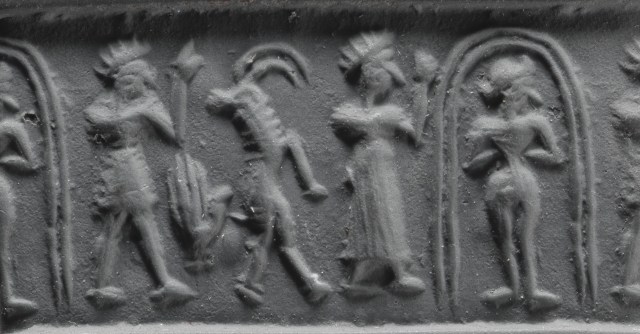
From here, we began to acknowledge a few curious commonalities between the different pantheons, such as the fact that almost every culture had one or more gods dedicated to fertility, harvest, and rainfall. Similarly, almost every culture had one or more gods dedicated to war, violence, chaos, and conquest. The list goes on.
Every one of these cultures and people groups had a prescribed set of rules, rites, and rituals for how to properly worship each god in their pantheon. Care to worship your god of the harvest? Perhaps you should offer some of your harvest as an offering – as a way of saying “thanks!” Care to worship your god of war? Perhaps you should go out and slaughter something or someone, or a whole bunch of someones. Then you can write songs and make declarations about the blood-thirstiness and power of your war god.
From there, we moved on to a powerful observation from the ancient near-eastern scholar, John Walton: “Like everyone else in the ancient world, the Israelites believed that everything that happened and everything that existed found its ultimate cause in deity.”
Good harvest this year? God did it. Drought this year? God did it. We developed a new form of literature, or a new musical instrument? God did it. We slaughtered a bunch of men, women, and children? God did it.
This ancient view is simultaneously puerile and sagacious. It is puerile, or foolish, given the many insights we have learned through our development of the physical sciences. God has ordered creation so as to be self-sustaining, providing rain and sunshine, fertilizer and so on, but it is the responsibility of the farmer to partner in the work of tilling the fields, planting the seeds, cultivating the plants and harvesting the rewards in due time. Without the farmer’s work, there would probably be no harvest. So also, in the case of combat and war, it’s usually the stronger force with the better fighters and the superior equipment who wins.
The ancient view, however, is incredibly sagacious, or wise and insightful, in the sense that it addresses the nearly infinite realms and unseen forces which, by definition, fall outside of the realm of the physical sciences. If I may be so bold, I think too many of us in the modern age have made an idol out of the physical sciences, and that which is “provable,” or “data-driven.” But that’s a point for another time.

From there, we began to draw some connections, realizing that Israel had been heavily influenced by the cultures and customs of the world around them. These cultures and customs undoubtedly penetrated into the Israelites’ own customs and practices. But to what extent?
We paused at this point to address a common objection (or obsession, as the case may be), which I generally refer to as Reductionism – reducing complex thoughts and ideas for the sake of simplicity, but at the cost of accuracy and truthfulness. The objection often goes something like this: “If a given culture or text presented an idea first, that means every other culture and people group who ever came up with a similar idea must have borrowed it from this original source, right?”
We took a brief, introductory look into the opening pages of Walton’s book, Ancient Near Eastern Thought and the Old Testament: Introducing the Conceptual World of the Hebrew Bible. We looked at a simple list of “filters” we should apply any time we’re engaging in the act of comparative studies (of ancient cultures). The simple truth of it is that some of the Bible, or at least a good deal of the Israelites’ habitual patterns, were probably absorbed or “borrowed” from the cultures, people groups, and texts around them. However, on the flip side of this simple truth, we also acknowledged that the subject matter borrowed in this way was probably not so great a quantity as some people would have us believe. (If you’re curious about this point, I encourage you to go back to part 6, or pick up a copy of Walton’s book and read it through).
Acknowledging that this could be a challenging observation for some people to accept, we offered a working “rule of thumb” by which to discern the authentic words of God from the borrowed ideas of the surrounding pagan nations: if an OT passage looks and sounds like Jesus (as revealed in the NT), there’s a good chance it’s an accurate picture of God, or an accurate transcription of something he instructed the Israelites to do. If an OT passage looks and sounds like the polytheistic beliefs and practices of the pagan nations surrounding Israel, there’s a good chance it’s not God, or not an accurate transcription of something God told the Israelites to do.

Having dealt with this objection, we returned to the final exploration of the first form of Biblical polytheism, and looked at a few case studies which showed the absolute centrality of deity in these ancient cultures. Many people were named so as to ascribe honor to a particular god or gods. We also looked at 15 different instances where the Israelites worshipped Canaanite gods (as listed in 2 Kings).
Adding this list of gods to the many gods listed in parts 3 and 4, we acknowledged the “elephant in the room.” It can be a dizzying and daunting task to consider all of these factors!
But I’m convinced it’s worth the effort.
When we take the time to consider and appreciate the “commonplace” world of the ancient Israelites, we can begin to make more sense of the “troublesome” passages we find in the OT. For example, did God ever really command the Israelites to murder and genocide the Canaanites? Probably not. The Israelites were simply following the forms and traditions of the cultures and pantheons surrounding them – attributing their violence as a command from God if they won, and attributing their losses to the anger and wrath, or punishment of God. Again, these are very common beliefs and assumptions within the polytheistic religions of the people historically surrounding Israel. When we add this to the myriad of OT passages explicitly forbidding violence and genocide (and hence, revealing the heart of God to be consistent with the heart of Jesus as seen in the NT), it seems obvious.
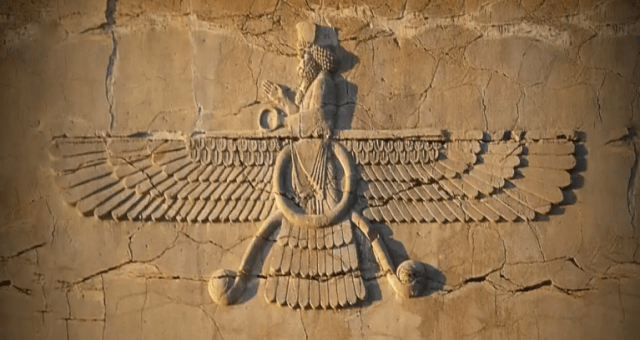
Having resolved these issues, we finally dove into the second form of Biblical polytheism. It is this second form which evaluates and informs our understanding of the unseen realms. It focuses on the role(s) of angels, demons, powers, principalities, rulers of darkness, spiritual forces of wickedness in the heavenly places (Eph. 6:12), and so on.
We took a moment to acknowledge that we are living in the 21st century, and most of us are not Palestinian Israelites. Ergo, we mustn’t make the silly mistake of thinking our modern English translations of the Bible are telling us the whole story (you might be surprised how many people believe this exact thing!). The Bible wasn’t originally written in 21st century English, but rather in ancient Hebrew, Aramaic, and Greek. Why does that matter? It matters because our languages use different words to describe different things, and in the case of ancient Hebrew (and to a lesser extent, ancient Greek), they had far fewer words to work with than we do now. It’s not an exact metric, but as a general rule of thumb, ancient Hebrew had about one word to every hundred words of ours in the modern English.
That means that while we might have a dozen, or even a hundred similar words to a describe a thing, oftentimes there would be one or maybe two words in Hebrew, which could mean all of those different things.
When it comes to certain words like “spirit,” “ghost,” “god,” or “angel,” we have to understand that these words meant many different things in Hebrew. For instance, the OT word for “spirit” is most often “ruach.” But ruach also means “wind,” “breath,” “exhalation,” or figuratively “life,” “anger,” or “unsubstantiality.” However, it can also refer to a region of the sky, and it can resemble the spirit of a rational being. More generically, it can refer to air, courage, vanity, cool, or even a tempest. From there, we can move into some of the variants and implied meanings, but I’ll spare us that exercise for now. Each one of our sample words listed above (spirit, ghost, god, angel) are similarly complex and expansive.
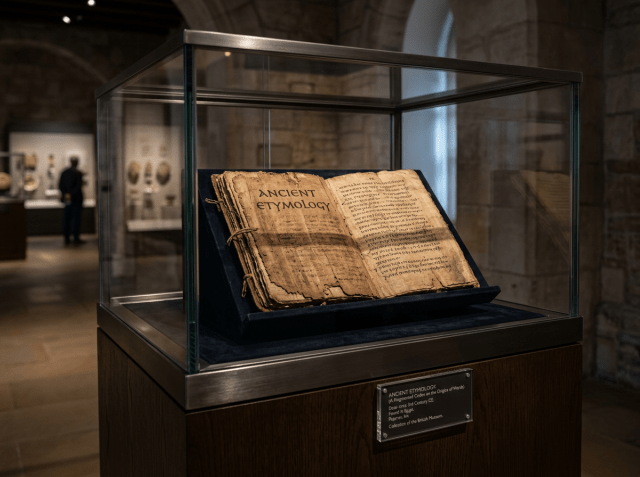
We then made a reference to Bullinger’s brilliant work, Figures of Speech Used in the Bible, and made the simple (but frustrating) observation that a great portion of the Biblical text is not literal, but in fact figurative.
This observation wasn’t raised so as to overwhelm us, nor to discourage any of us from reading and studying the Word of God. On the contrary, the hope was that this simple understanding would help to foster a greater appreciation for the original text and language of the Bible – to inspire within us a greater depth of understanding, and a greater desire to rebel against over-simplification and reductionistic theology.
We then began applying these principles to various word studies, looking at the words used in Hebrew and Greek for the many English words we use to talk about God, the gods, angels, demons, spirits, ghosts, powers, principalities, unseen forces, and the like. In simple terms, the ancient Israelites (as well as us) were polytheistic in this second sense, which is to say that they (and us) believed in the existence of supernatural forces. Because of their original languages, the words we think of as polytheistic (namely “gods” or “demigods”) didn’t necessarily mean the same thing to the Biblical authors, or to the Israelites in general. So also, many of us refer to entities like “demons” or “devils,” but neither of these words show up in the OT Hebrew. It turns out that these entities we refer to as “demons” or “devils” would most accurately translate into the Hebrew word(s) for “god(s)” or “spirit(s)” or something else.
In short, while the first form of Biblical polytheism refers to the times when the ancient Israelites worshipped false gods, the second form of Biblical polytheism simply acknowledges the existence of supernatural, non-material beings. (Feel free to conduct your own language survey if you would like to know more about the linguistic differences between modern English and the original languages of the Biblical texts)
We finally spent a couple of weeks observing some examples of the words and names the Israelites used to refer to some of these unseen forces. We also looked at a few case studies revealing curious observations about the nature of the unseen realms.
Several years ago, I posted a blog entitled “Practical Polytheists,” where I gave a few examples of the ways in which we often worship false gods in practice, even if not in name. This is referring to the first form of Biblical polytheism – the form we ought to avoid. Here’s an excerpt:
Many, if not most, people today are what I would describe as practical polytheists. Oh sure, we’ve gotten away from giving proper names to our modern idols, but they’re effectively the same gods the Israelites flirted with throughout the Old Testament.
Adrammelech was the Sepharvite god of war and love (see 2 Kings 17:31). Nebo, after whom was named a mountain and several towns (see 1 Chronicles 5:8), was the god of wisdom, literature and the arts. Ashtoreth, also referred to as Astarte or Ishtar, was the Sidonian goddess of sex and fertility (see 2 Kings 23:13). And of course Jesus addressed the worship of Mammon in the gospels. Mammon seems to be an Aramaic rendering of the Roman god, Pluto, or the Greek god Plutus, and represents greed and dishonest gain.
So maybe you don’t worship Adrammelech, but do you crave violence, war or the power to control? Do you worship key relationships in your life, making them the chief focus of your attention?
Maybe you don’t worship Nebo, but do you worship knowledge, progress or artistic expression?
And maybe you don’t worship Mammon, but do you crave what others have? Do you worship the idea of financial abundance, thinking that if you can just “get enough” and “have enough” that life will be all good?
As is often the case, when we “peel back a layer” of Scripture or history, we realize that we’re not so very different from those old superstitious simpletons after all. And so it is that the guidance and wisdom God gave to them also applies to us, to neglect our idols in favor of God, who is all-in-all, and who is life abundant. Our fulfillment is not found in obtaining this or that, nor in achieving this or that, but rather in discovering the One who made us, and walking each day, each moment beside Him.
And so here we find ourselves at the end of this little survey on the Polytheism Context Clue. What words do I offer as we close this series? Two things.
First, mere belief in the existence of God does you no good, just as the mere belief in the existence of other unseen gods/forces/angels/demons/powers/principalities does you no bad. Consider the reminder of James 2:19. “You believe in God? Great! So do the demons, and they at least have the decency to shudder.” (paraphrased) There is, however, a significant difference between believing in God, and worshipping Him wholeheartedly. In the same way, there’s a difference between believing in the powers/principalities/etc and worshipping them. The second form of Biblical polytheism acknowledges existence, but the first form bows down and worships. And that can look like any idol you can think of: comfort, ease, knowledge, status, friends, relationships, accomplishments, doubts, fears, etc.
That brings me to my second, and final, thought, which is an ancient, and beautiful charge from Joshua at the end of his life to the Israelites. The words are exceptionally timely and relevant to each one of us today: “Choose this day whom you will serve.” (Josh. 24:15b) Today is “this day,” and tomorrow, when it arrives, will be “this day.” It is a constant, eternal reminder for us to choose each day, each moment, whom we will serve. I would encourage each of us to adopt Joshua’s pledge: “As for me and my house, we will serve the Lord.” (Josh. 24:15e)
Choose an amount
Or enter a custom amount
Your contribution is appreciated.
Your contribution is appreciated.
Your contribution is appreciated.


I finished the previous post with a bold claim.
I suggested that, ‘yes,’ the Israelites were polytheists in a sense. I further went on to explain why I think we’re all equally polytheistic in the same way. Feel free to go back and give part 10 a read so as to refresh yourself on the context and explanation of my claims.
We ended the post by substituting the word ‘god’ with the words/concepts from Paul’s epistle to the churches in Ephesus. “For our struggle is not against flesh and blood, but against the rulers/principalities (ar-khay), against the powers (exsousia), against the rulers of the darkness in this world/age (kosmokrator ho skotos toutou aion/eon), and against the spiritual (pnuematikos) forces/wickedness (poneria) in the high/heavenly places (epouranios).”
Now of course Paul’s letter was written in Greek, so we have to do a bit of translating (see parts 8 & 9 again) in order to see the corollaries in Hebrew, but this gives us a strong vocabulary to work with in our conversations regarding Biblical polytheism.
Here’s a fun example. Did you know that pre-Islamic Arabian and ancient Middle-Eastern folklore – which heavily involved nomadic tribes like the Midianites (Moses’ in-laws) – teemed with beliefs about invisible spirits and demons? The desert wilderness was considered to be the domain of the Jinn (nature spirits born of smokeless fire) and malevolent entities. These spirits were thought to possess people, cause disease, and inhabit desolate or impure places, forcing desert travelers to employ protective customs.

This simple insight helps to explain the actions of Zipporah (Moses’ wife, and the daughter of Jethro, the Midianite priest) in Exodus 4:25. She was acting out the “protective custom” for dealing with malevolent Jinn, as explained to her by her priestly father. This also explains one of Israel’s biggest reasons for being reluctant to leave Egypt in the first place. Not only was Moses trying to take them away from the land protected by Ra and Horus to wander into Set’s domain (which also happened to be the domain of the Jinn), but they would have to cross the Red Sea – the domain of the Canaanite god, Yam (or “Rahab,” if you prefer), or the Babylonian equivalent, Tiamat.
Frankly, it’s a bit of a miracle that the Israelites ever left Egypt! Sure their lives sucked. They were slaves, and third-class citizens, but… going into the desert? The wilderness? Having to cross the chaotic sea first to even get there? What insanity!
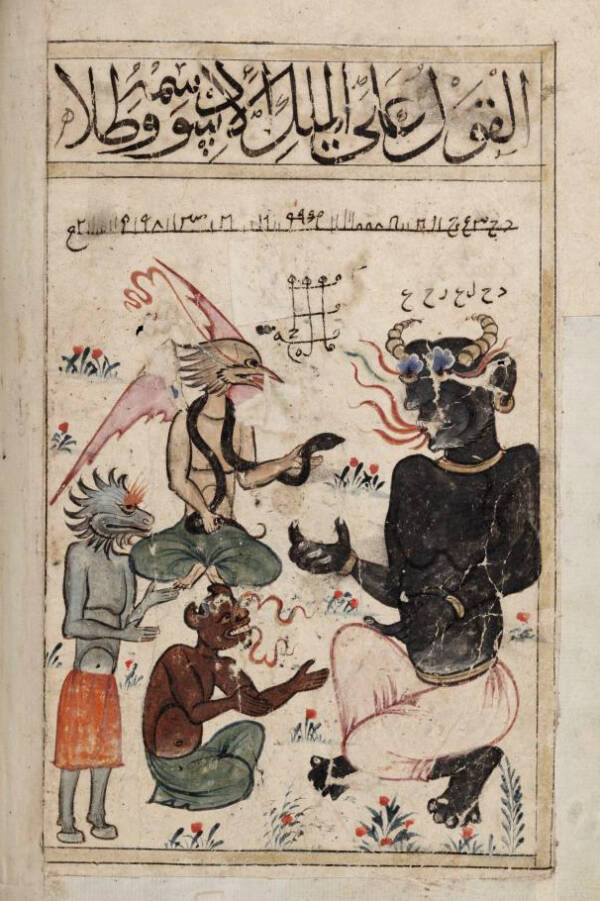
I think this is one of the most significant reasons for the ten plagues in Egypt. They weren’t only about convincing the Pharaoh that the Lord is God (although that was certainly a part of it). I think the bigger part was about convincing the Israelites that the Lord is God. If He could overpower the “substantial might of the Egyptian pantheon,” He might just be able to travail over Yam and Tiamat, and then He might just be able to protect them from the demons and Jinn of the wilderness. Who knows? He might even be able to travail against the local gods of the Hittites, Amorites, Jebusites, Hivvites, Sepharvites, Canaanites, and all the others.
This is an interesting observation by itself, but it also provides us with a secondary insight: the ancient Israelites (along with everyone else) believed in the regional/geographical reign of certain deities and spirits. We see this clearly in the examples above. The Jinn, along with other invisible spirits and demons (and Set, if you’re Egyptian) ruled in the wilderness and deserts. Yam and Tiamat reigned in the oceans, and were described as beings of incredible chaos and destruction. If you wanted to avoid these destructive gods, you should avoid the places where they live and reign and cause chaos.
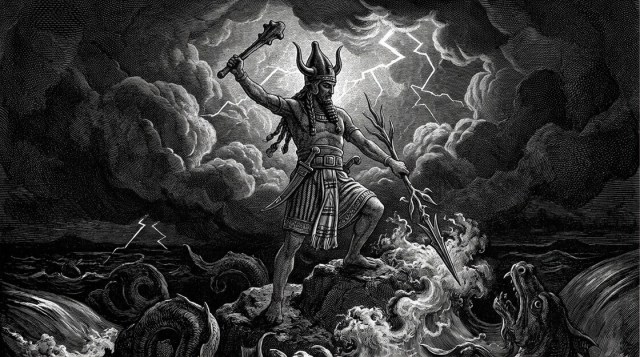
This belief is prevalent across many ancient writings, and we see it in the Scriptures as well. Take Daniel 10, for example. Daniel had seen a vision of “great conflict” (v. 1) which caused him to mourn (and presumably pray, as was his custom – see Daniel 6) for three entire weeks (v. 2). Finally, he was greeted by an angel. As the angel speaks, we see a strange revelation in verses 12 and 13:
Then he [the angel] said to me, “Do not be afraid, Daniel, for from the first day that you set your heart on understanding this and on humbling yourself before your God, your words were heard, and I have come in response to your words. But the prince of the kingdom of Persia was opposing me for twenty-one days; then behold, Michael, one of the chief princes, came to help me, for I had been left there with the kings of Persia.
This is strange to us if we don’t think about it. But if we do think about it, a lot of things begin to fall into place. The angel here in Daniel 10 was being “physically restrained,” or whatever the closest spiritual equivalent is to that. Why wasn’t the angel simply “ported” to Daniel immediately? Why is it described like he had to go on a journey to reach Daniel?
Perhaps because he did.
We know precious little about how the spiritual realm actually works, so who’s to say it doesn’t have a physical component like our material world does? In fact, some of the leading theories regarding eternity (that is the Biblical term for the spiritual realm, by the way – it’s not just another word for “forever”) view it as something like an “overlapping dimension” of our reality. In other words, our physical/material dimensions of reality are shared with the “unseen” dimensions of reality – such as the spiritual realm (or “heaven,” if you prefer). This makes a lot more sense when we consider the Biblical passages on the subject, as well as the classical pagan views of the afterlife, but that’s a tangent for another day.
Alright, all of this “Old Testament hoodoo-ism” might be freaking you out a bit, so let’s take a look at a New Testament example of the same principle. Matthew, Mark, and Luke all record the events of Jesus and His disciples traveling to the shore of the Gerasenes, where they were met with a man possessed by an entire legion of demons! Luke adds a few interesting details in his account.
“What business do we have with each other, Jesus, Son of the Most High God? I beg You, do not torment me…” They [Legion] were imploring Him not to command them to go away into the abyss… the demons implored Him to permit them to enter the [nearby] swine. And He gave them permission. (selections from Luke 8:26-33)
Did you catch it? The demons didn’t want to be sent “away.” They would rather drown with the pigs in their home country than be sent away to the abyss. What a strange insight. So where does that leave us?
In a world of pantheons and regional gods, we begin to see a different picture emerging about how the spiritual realm actually works. According to the widespread traditions of the ancient people, and the reinforced examples we find in the Scriptures themselves, the ancient model(s) of Biblical polytheism look quite different than we might have supposed. Not only that, but our increased understanding of the ancient Israelites’ world view has made a significant impact on the way we, ourselves view God, and the gods.
I hope you’ll join us next week as we bring this series to a close with a brief summary and a few take-home applications.
Choose an amount
Or enter a custom amount
Your contribution is appreciated.
Your contribution is appreciated.
Your contribution is appreciated.
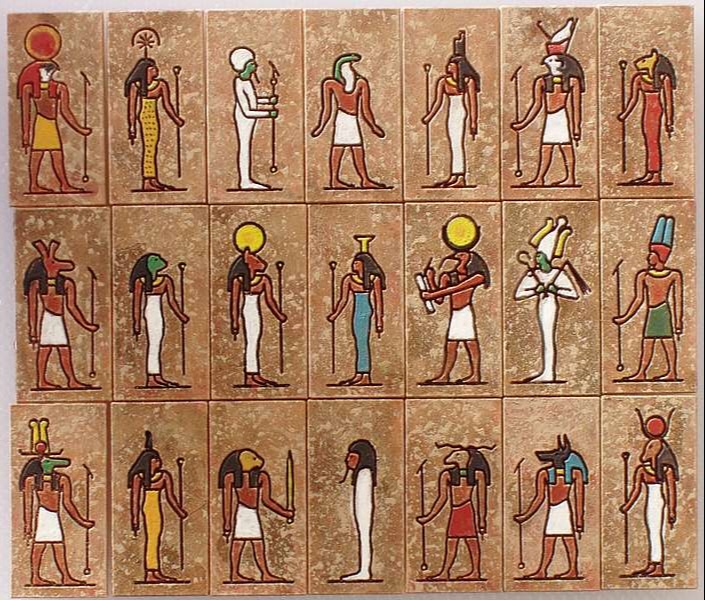
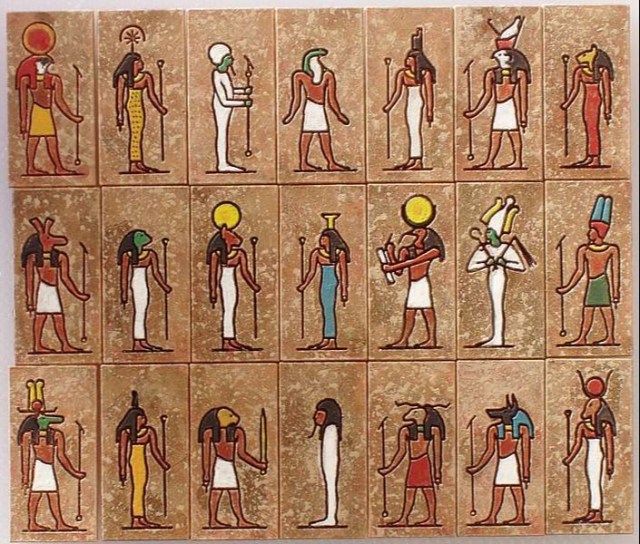
Okay, so were the ancient Israelites polytheists or not?
What a wonderfully direct and pointed question. The answer, as you might have suspected, is much less direct and pointed: it depends. What do we mean when we use the word ‘polytheist?’
If you’ve been following along in the series, you’ll know that I’ve been focusing on two forms of Biblical polytheism, and if you haven’t been following the series, I’d suggest going back and reading the earlier parts – they really do build upon each other.
So why would I say that it depends what we mean by the word ‘polytheist?’ It’s a rather straightforward question, right? The answer should be a straightforward ‘yes’ or ‘no,’ so what’s the complication?
One of the complications is that there are multiple types of logic in the world, many of which are regularly employed by ourselves and others. Some have posited just two forms of logic, but there are more, and logic itself is one of the contributing factors to our world view lens (the way in which an individual views the world and everything in it).
I don’t want to go too deep on this tangent, but a brief illustration might be helpful to our present conversation, so I’ll emphasize two of the most well-known types of logic. In layman’s terms, the first view is the one we talk about the most in our modern Western culture, and that is the “either/or” school of logic. In more academic terms, this references the four fundamental laws of logic built on the foundational principle of non-contradiction. Either a statement is true, or it is false.
The second type of logic I want to mention is the “both/and” school of logic. In layman’s terms, this refers to the occasions when a statement is both true and false. This type of logic is sometimes assumed to be an Eastern concept, but that’s not accurate. Both forms of logic (the either/or and the both/and) are regularly employed across all people groups, times, and cultures. That’s as far as I’ll tread down this particular rabbit hole for now. If you’re interested in learning more about the different types of logic, look it up – do a research project. Nobody’s stopping you.

Okay, so back to our first question: were the ancient Israelites polytheists or not? I dare say the correct answer is both ‘yes’ and ‘no.’ (Do you like how I’ve employed the second form of logic here?) Our immediate follow up question, then, is: “what do you mean?”
Let’s start with the Shema in Deuteronomy 6:4,5.
Hear, O Israel! The Lord is our God, the Lord is one! You shall love the Lord your God with all your heart and with all your soul and with all your might.
When Israel was at their best, I believe they were mostly (or completely) worshipping the Lord alone, above all other gods. So in that sense, ‘no,’ the Israelites weren’t polytheists – they weren’t sharing their worship with other gods; they weren’t viewing other gods as equals to Yehovah. (And as we’ve mentioned before, there were quite a few times when they ran off after other gods, as well).
However, the way the ancient Israelites viewed things like gods, spirits, angels, demons, powers, principalities, and other spiritual forces was much more similar to the way everyone else in the ancient world thought about these things. Namely, the existence of numerous gods (spirits, powers, principalities, etc.) was never in question. Everyone believed in a rich and expansive spiritual realm – a place where the gods (etc.) lived and reigned in force. At certain times and occasions and places, one or more of the “gods” would act upon the physical world in a way that was (usually) consistent with their nature. And if you want a brief refresher on the “nature” of some of the gods in the pantheons surrounding ancient Israel, go back and look at parts 3 & 4 in this series.
To quote John Walton once more: “Like everyone else in the ancient world, the Israelites believed that everything that happened and everything that existed found its ultimate cause in deity.”
So in that sense, ‘yes,’ the Israelites were polytheists. And if I can be so bold as to offer a controversial statement, I think that we are all polytheists in the same way.
Before you start hurling stones at me, let’s swap out the word ‘god’ with something else. I know the word ‘god’ can be a bit of a trigger word for modern Christians. As you’ll remember from parts 8 & 9 in this series (go back and check them out if you like), the Hebrew words for ‘god’ and ‘spirit’ mean a whole lot of different things because their language had so many fewer words than modern English does, and they had to accomplish much more with each word.
For our sakes, let’s substitute the word ‘god’ with the words/concepts from Paul’s epistle to the churches in Ephesus. “For our struggle is not against flesh and blood, but against the rulers/principalities (ar-khay), against the powers (exsousia), against the rulers of the darkness in this world/age (kosmokrator ho skotos toutou aion/eon), and against the spiritual (pnuematikos) forces/wickedness (poneria) in the high/heavenly places (epouranios).”
Now of course Paul’s letter was written in Greek, so we have to do a bit of translating (see parts 8 & 9 again) in order to see the corollaries in Hebrew, but this gives us a strong vocabulary to work with in our conversation regarding Biblical polytheism.
For the sake of time, I’ll wrap up this week’s post here. Next week, we’ll take a look at a few practical examples of how this second form of Biblical polytheism functions in action. I hope to see you then!
Choose an amount
Or enter a custom amount
Your contribution is appreciated.
Your contribution is appreciated.
Your contribution is appreciated.
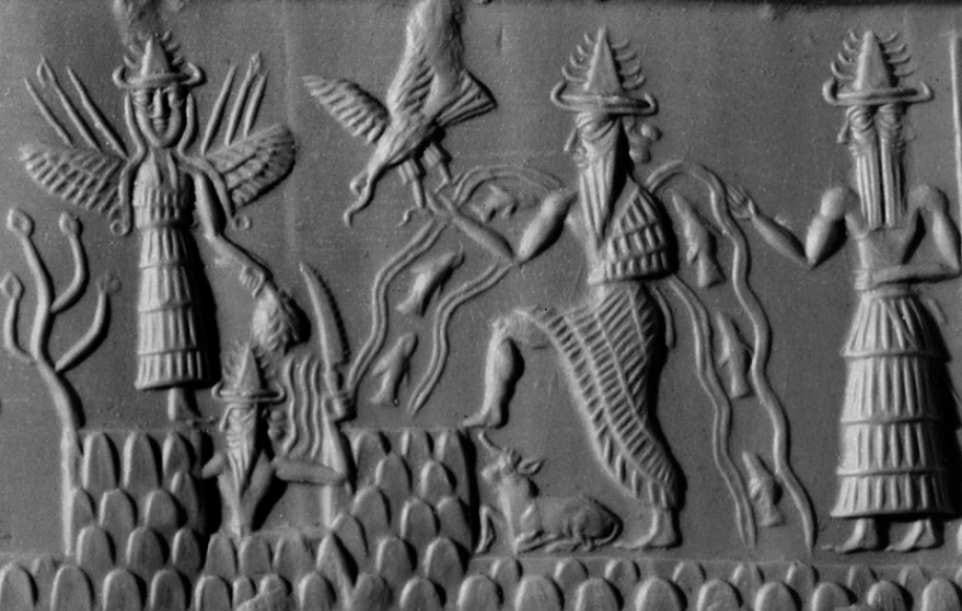
Do you believe in ghosts?
What about angels? Demons? Spirits? Gods?
Last week, we took a moment to remember that the Bible was first written in a time that is not our own, in a place that is not our own, to a people and culture who are not our own. That means that any of us who read the Bible in English, or any other language apart from the original Hebrew, Aramaic, and Greek, are in great danger of misunderstanding the depth of meaning used in the original Biblical texts. This misunderstanding, if left unchecked, can result in a myriad of dreadful misinterpretations of Scripture, and a whole category of poor theology I refer to as Reductionism (reducing complex thoughts and ideas for the sake of simplicity, but at the cost of accuracy and truthfulness).
The reason we study context in all its various forms is that it helps us to peel back the many dreadful layers of misunderstanding which naturally occur whenever we read the Bible through a translation.
Which translation is the best? NASB? KJV? ESV? NIV? NLT? Living Letters? Amplified? Message? Passion? Are you ready for this? They’re all good, but they’re also all bad.
Why? Because they are translations, and not the original text. As you’ll remember from the previous post in this series, modern English (by some estimations) has nearly 100-times as many words as the ancient Hebrew language. And while this rule of thumb is not exact, it can be a helpful illustration to consider that each word of the OT means approximately 100 different things in the modern English language. That makes it quite the impossible task for Bible translators to know for certain how best to translate the various passages of Scripture. Some default to a more literal translation, which has its merits and faults, and others prefer a more figurative translation, which has its merits and faults. Still others prefer to blend the literal and figurative translations, which has its merits and its faults.
So we have to ask ourselves, is this a lost cause – trying to translate the Bible into other languages? Not necessarily. Through a comprehensive study of the various forms of context (literary, geographic, chronological, cultural, textual, relational, functional) we can begin to translate the words with greater confidence. It is worth mentioning, however, that every time we approach the Scriptures, whether for the purposes of translation, or devotional reading, or even study, we must approach the Scriptures with a humble and contrite spirit. The fact of the matter is that we will probably never fully know every nook and cranny of the Scriptures and their complete meanings, so humility is the only reasonable approach. From the freshly born-again Christian to the wisened Bible scholar, we’re all equally wise to approach our infinite God in light of the knowledge that we are finite. That means we will never fully understand His infinity. For my part, I find this to be remarkably encouraging. It lifts the weight of the universe off of my shoulders. Hopefully you feel the same way.
Okay, let’s get back to the opening questions, but we’ll frame them a little differently. Did the ancient Israelites believe in ghosts? What about angels? Demons? Spirits? Gods?
If you answered ‘yes’ to all of the above, I would like to reward you with a gold star. Sadly, there’s no room left in the budget, so I’m afraid you’ll have to provide your own gold star.
“But how can this be?” you might ask. “Didn’t the Israelites believe that there is only one God?”
Well, yes and no.
Yes in the sense you’re probably thinking. The Israelites did believe that Yehovah (Yahweh) was and is the One true God of Creation. A quick look at Deut. 6:5 makes this apparent. But of course, they struggled with fidelity to the One true God, and often ran off to worship idols and pagan gods.
However, “no” in the sense that “god” didn’t mean the same thing to the ancient Israelites as it does to us.
The word most commonly translated as “god” in the OT is the Hebrew word “Elohim,” which is the plural form of “Eloah,” or if you prefer the Arabic variant, “Allah.” It is often used in the short form, “El,” which is a word signifying strength, as in “El-Shaddai” (God-Almighty). The etymology is uncertain, but it is generally agreed that the primary idea is one of strength, or power of effect. The plural form of Elohim doesn’t refer to the trinity of persons within the Godhead, but rather to the fullness of divine strength, or the sum of the powers displayed by God.
However, the word “Elohim” was also used as a term of reverence for a local magistrate. Other times, it was used as a superlative, referring to angels, gods, goddesses, and even great and mighty people.
You may be further interested to learn that there is no Hebrew word for demons or devils in the OT, although there is considerable mention of them in the NT (which was primarily written in Greek). The adversarial forces of darkness in the OT were normally referred to by their occupational titles, such as the destroyer (“Shawkath”), or the adversary (“Satan”). In most of the other occurrences, demons and devils are simply referred to as spirits (“Ruach”), or perhaps “unclean spirits” as in Zech. 13:2 (“Toomaw Ruach”).
You may remember from last week that ruach also means “wind,” “breath,” “exhalation,” or figuratively “life,” “anger,” or “unsubstantiality.” However, it can also refer to a region of the sky, and it can resemble the spirit of a rational being. More generically, it can refer to air, courage, vanity, cool, or even a tempest. And the list goes on from there.
When we consider this list, we can appreciate a few of the possible applications of the word “ruach.” In some cases, this may be referring to a spirit of anger, or a spirit of the air. Other times, it refers to a spirit of courage or vanity.
With so many possible applications for Biblical words like “god” and “spirit,” we’re beginning to appreciate how each of the related concepts (angels, demons, powers, principalities, etc.) holds a myriad of similar possible applications.
Next week, we’ll look at a few more of these applications and apply some of the names the Israelites likely ascribed to these various spirits, gods, and unseen forces in an attempt to better “understand” and relate to the world they lived in.
Choose an amount
Or enter a custom amount
Your contribution is appreciated.
Your contribution is appreciated.
Your contribution is appreciated.
Have a WordPress.com account? Log in now.

