


I finished the previous post with a bold claim.
I suggested that, ‘yes,’ the Israelites were polytheists in a sense. I further went on to explain why I think we’re all equally polytheistic in the same way. Feel free to go back and give part 10 a read so as to refresh yourself on the context and explanation of my claims.
We ended the post by substituting the word ‘god’ with the words/concepts from Paul’s epistle to the churches in Ephesus. “For our struggle is not against flesh and blood, but against the rulers/principalities (ar-khay), against the powers (exsousia), against the rulers of the darkness in this world/age (kosmokrator ho skotos toutou aion/eon), and against the spiritual (pnuematikos) forces/wickedness (poneria) in the high/heavenly places (epouranios).”
Now of course Paul’s letter was written in Greek, so we have to do a bit of translating (see parts 8 & 9 again) in order to see the corollaries in Hebrew, but this gives us a strong vocabulary to work with in our conversations regarding Biblical polytheism.
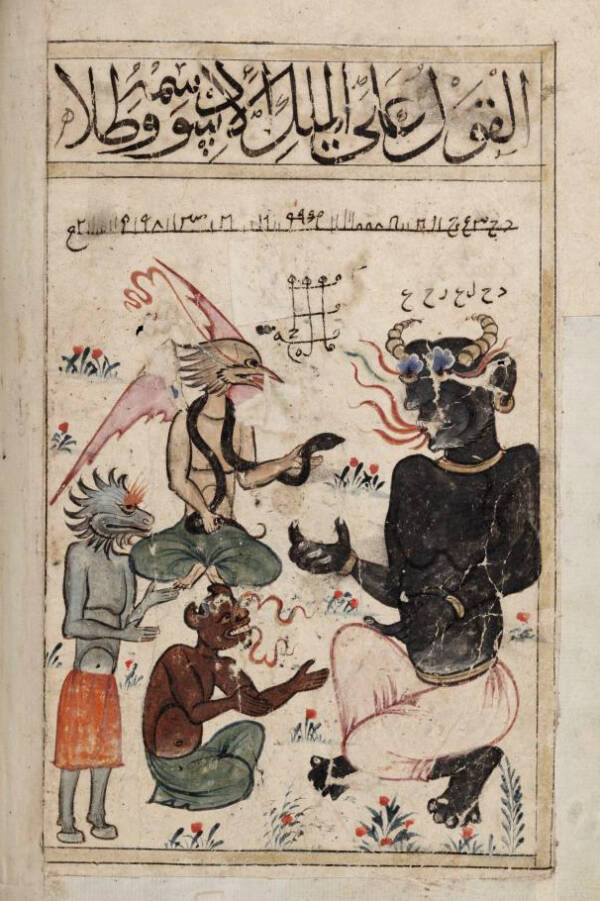
Here’s a fun example. Did you know that pre-Islamic Arabian and ancient Middle-Eastern folklore – which heavily involved nomadic tribes like the Midianites (Moses’ in-laws) – teemed with beliefs about invisible spirits and demons? The desert wilderness was considered to be the domain of the Jinn (nature spirits born of smokeless fire) and malevolent entities. These spirits were thought to possess people, cause disease, and inhabit desolate or impure places, forcing desert travelers to employ protective customs.
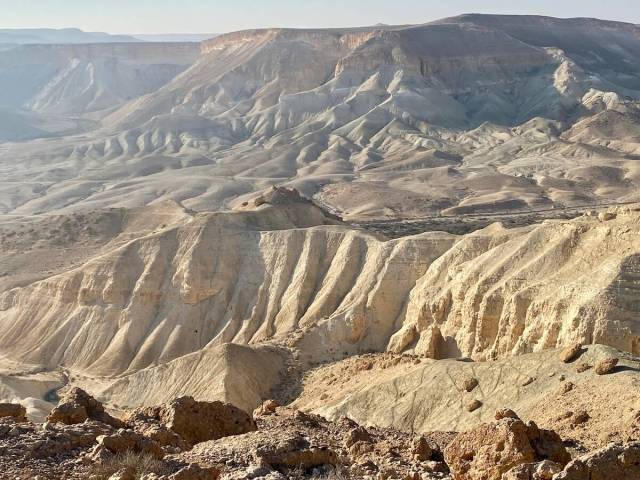
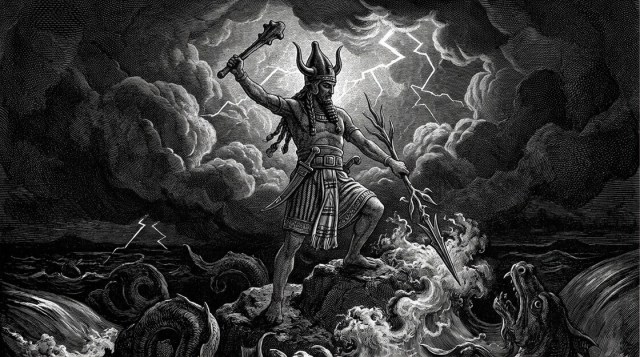
This simple insight helps to explain the actions of Zipporah (Moses’ wife, and the daughter of Jethro, the Midianite priest) in Exodus 4:25. She was acting out the “protective custom” for dealing with malevolent Jinn, as explained to her by her priestly father. This also explains one of Israel’s biggest reasons for being reluctant to leave Egypt in the first place. Not only was Moses trying to take them away from the land protected by Ra and Horus to wander into Set’s domain (which also happened to be the domain of the Jinn), but they would have to cross the Red Sea – the domain of the Canaanite god, Yam (or “Rahab,” if you prefer), or the Babylonian equivalent, Tiamat.
Frankly, it’s a bit of a miracle that the Israelites ever left Egypt! Sure their lives sucked. They were slaves, and third-class citizens, but… going into the desert? The wilderness? Having to cross the chaotic sea first to even get there? What insanity!
I think this is one of the most significant reasons for the ten plagues in Egypt. They weren’t only about convincing the Pharaoh that the Lord is God (although that was certainly a part of it). I think the bigger part was about convincing the Israelites that the Lord is God. If He could overpower the “substantial might of the Egyptian pantheon,” He might just be able to travail over Yam and Tiamat, and then He might just be able to protect them from the demons and Jinn of the wilderness. Who knows? He might even be able to travail against the local gods of the Hittites, Amorites, Jebusites, Hivvites, Sepharvites, Canaanites, and all the others.
This is an interesting observation by itself, but it also provides us with a secondary insight: the ancient Israelites (along with everyone else) believed in the regional/geographical reign of certain deities and spirits. We see this clearly in the examples above. The Jinn, along with other invisible spirits and demons (and Set, if you’re Egyptian) ruled in the wilderness and deserts. Yam and Tiamat reigned in the oceans, and were described as beings of incredible chaos and destruction. If you wanted to avoid these destructive gods, you should avoid the places where they live and reign and cause chaos.
This belief is prevalent across many ancient writings, and we see it in the Scriptures as well. Take Daniel 10, for example. Daniel had seen a vision of “great conflict” (v. 1) which caused him to mourn (and presumably pray, as was his custom – see Daniel 6) for three entire weeks (v. 2). Finally, he was greeted by an angel. As the angel speaks, we see a strange revelation in verses 12 and 13:
Then he [the angel] said to me, “Do not be afraid, Daniel, for from the first day that you set your heart on understanding this and on humbling yourself before your God, your words were heard, and I have come in response to your words. But the prince of the kingdom of Persia was opposing me for twenty-one days; then behold, Michael, one of the chief princes, came to help me, for I had been left there with the kings of Persia.
This is strange to us if we don’t think about it. But if we do think about it, a lot of things begin to fall into place. The angel here in Daniel 10 was being “physically restrained,” or whatever the closest spiritual equivalent is to that. Why wasn’t the angel simply “ported” to Daniel immediately? Why is it described like he had to go on a journey to reach Daniel?
Perhaps because he did.
We know precious little about how the spiritual realm actually works, so who’s to say it doesn’t have a physical component like our material world does? In fact, some of the leading theories regarding eternity (that is the Biblical term for the spiritual realm, by the way – it’s not just another word for “forever”) view it as something like an “overlapping dimension” of our reality. In other words, our physical/material dimensions of reality are shared with the “unseen” dimensions of reality – such as the spiritual realm (or “heaven,” if you prefer). This makes a lot more sense when we consider the Biblical passages on the subject, as well as the classical pagan views of the afterlife, but that’s a tangent for another day.
Alright, all of this “Old Testament hoodoo-ism” might be freaking you out a bit, so let’s take a look at a New Testament example of the same principle. Matthew, Mark, and Luke all record the events of Jesus and His disciples traveling to the shore of the Gerasenes, where they were met with a man possessed by an entire legion of demons! Luke adds a few interesting details in his account.
“What business do we have with each other, Jesus, Son of the Most High God? I beg You, do not torment me…” They [Legion] were imploring Him not to command them to go away into the abyss… the demons implored Him to permit them to enter the [nearby] swine. And He gave them permission. (selections from Luke 8:26-33)
Did you catch it? The demons didn’t want to be sent “away.” They would rather drown with the pigs in their home country than be sent away to the abyss. What a strange insight. So where does that leave us?
In a world of pantheons and regional gods, we begin to see a different picture emerging about how the spiritual realm actually works. According to the widespread traditions of the ancient people, and the reinforced examples we find in the Scriptures themselves, the ancient model(s) of Biblical polytheism look quite different than we might have supposed. Not only that, but our increased understanding of the ancient Israelites’ world view has made a significant impact on the way we, ourselves view God, and the gods.
I hope you’ll join us next week as we bring this series to a close with a brief summary and a few take-home applications.
Make a one-time donation
Make a monthly donation
Make a yearly donation
Choose an amount
Or enter a custom amount
Your contribution is appreciated.
Your contribution is appreciated.
Your contribution is appreciated.


There is a very good reason, to add to this, as to why we are encouraged to put on the Full Armor of God every day and we are encouraged to pray without ceasing, not just in the morning, during study sessions, before meals, etc, and to be in fellowship with like minded fellow believers more frequently than not and in that fellowship to be in the Word together, be in prayer together and to be in worship (praising and honoring God) together. You also, link up the Full Armor with the fruit of the spirit and with the Spiritual Gifts, we are equipped to defend and take action to navigate this other dimension of “. . . the rulers/principalities (ar-khay), against the powers (exsousia), against the rulers of the darkness in this world/age (kosmokrator ho skotos toutou aion/eon), and against the spiritual (pnuematikos) forces/wickedness (poneria) in the high/heavenly places (epouranios).”
But, to note; polytheism; the belief in many gods, we are told specifically that we can’t server two masters. A person who is following Christ would also be one who would choose to intentionally not be polytheistic in their belief system. So, I for one, do not believe in many gods and for sure would not ever go and worship multiple gods. Now, that is not to say that my flesh wont battle against what I know is right and true as the Holy Spirit guides me in my navigation of life. From hence I might stumble as I give into the lure and temptation of temporary sinful delights and will then need to return in repentance, because I did not fully arm myself in preparation of the daily battle. The Holy Spirit isn’t here to stop us from making bad choices.
I like your series, it is thought provoking and you are making a lot of good biblically sound observations. Keep up the good work in Christ.
LikeLike